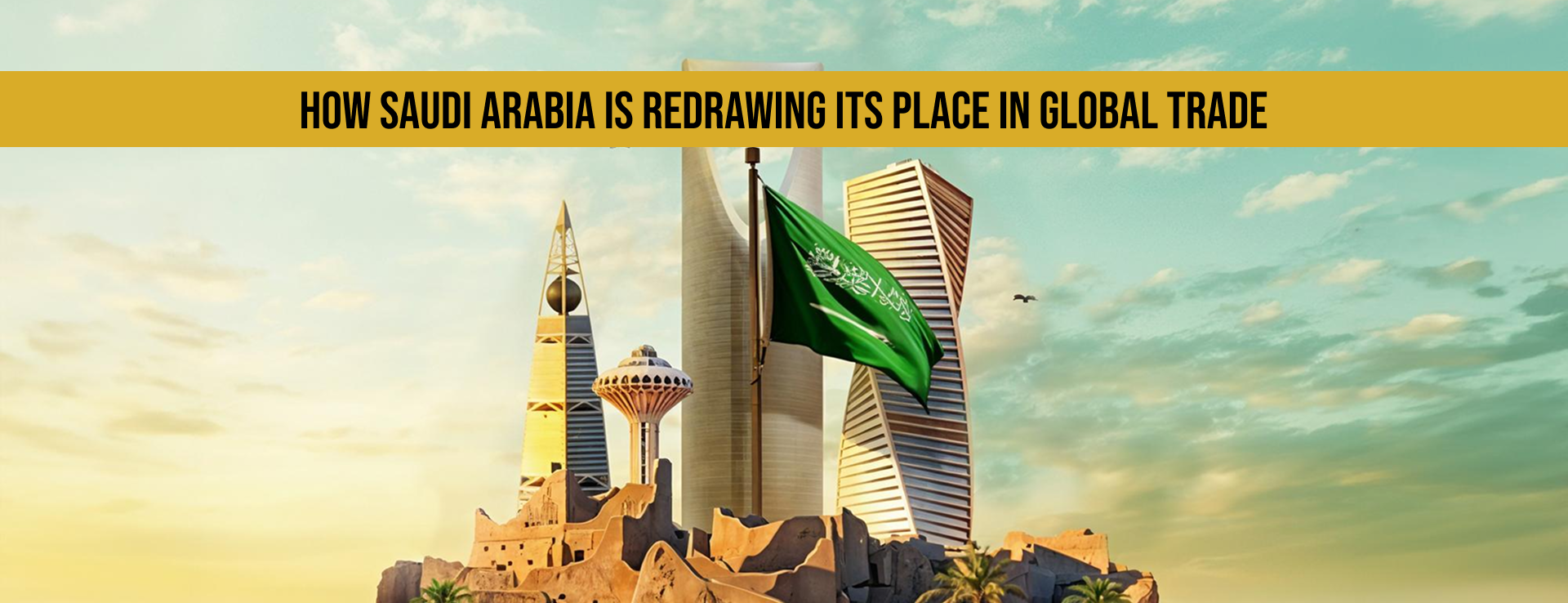

How Saudi Vision 2030 Is Reshaping Global Economic and Trade Relationships?
Saudi Arabia's Vision 2030 is not simply a domestic development plan. It’s a roadmap that’s pushing one of the world's high-income and wealthy countries into a new economic position in the global market. Launched in April 2016 by Crown Prince Mohammed bin Salman, Saudi Vision 2030 is an ambitious program involving strong objectives. One of the major ones is decreasing the total dependence on oil reserves and building an economy that can compete within multiple sectors at a global level.
After a decade today, the effects are not just visible inside Saudi Arabia but in its trade flows, investment flows, bilateral alignments in Asia, Europe, Africa and beyond. The Saudi Vision 2030 digs a deeper story about how a country that once exported almost nothing but hydrocarbons is quietly rearranging its position in global supply chains, investment corridors, and multilateral forums.
Why Diversification Became Essential?
The oil industry in Saudi accounted for its government revenue and export earnings for decades. Shifting away from it wasn’t a sudden idea but a fact of gradual understanding that relying on a single, volatile commodity was a risky way to run a country. Though oil revenues still play a crucial role, diversifying output naturally reshapes trade patterns. It also changes what a country imports and exports, and where it invests. Saudi Arabia's expanding manufacturing base means it's importing more industrial equipment. Its growing tourism sector creates demand for hospitality and aviation supply chains. Its mining push brings in foreign expertise and capital from regions that had little prior economic interaction with the Kingdom. Each sector addition creates a new thread of international economic connection.
Vision 2030 at a Glance: What the Strategy Aims to Change
The Saudi Vision 2030 rests on three main connected pillars: a vibrant society, a thriving economy, and an ambitious nation. In practice, the economic pillar does the most work internationally. The goals include raising private sector contribution to GDP from 40% to 65%, reducing oil's share of government revenue, and attracting $100 billion in FDI annually by 2030.
They foster ties among the countries and Saudi Arabia that extend well beyond exporting oil and importing consumable goods. Countries interact with Saudi Arabia through technology transfer, joint ventures, infrastructure cooperation, and long term strategic agreements.
The Transformation of Investment Flows
Foreign Direct Investment (FDI) has become the new metric of success for Saudi and it has grown considerably since announced. Before Vision 2030, Saudi Arabia averaged roughly $11.5 billion in annual FDI inflows (2013-2015). That figure reached $31.8 billion in 2024 - a 24.2% increase year-on-year and the fourth consecutive year exceeding national investment targets. It’s not just about the money flowing in, but the expertise and partnerships that come with it. Through the Public Investment Fund (PIF) and revised regulatory frameworks, the Kingdom is aggressively courting global investors. The PIF operates as the central vehicle for this transformation, with more than $900 billion in assets under management in 2024. It's not just deploying capital inside Saudi Arabia - it's building bilateral relationships through overseas stakes, joint ventures, and co-investment arrangements. A $500 million joint venture with Hyundai Motor Group to build a Saudi EV plant, expected to start production in 2026, is one visible example of how FDI is moving from passive capital to active industrial partnership.
New Regional & Global Trade Partnerships
Saudi Arabia's trade relationships are diversifying on both sides - what it exports and who it trades with. Historically, Saudi Arabia largely exported oil while importing most manufactured and consumer goods. That's changing. Vision 2030 has pushed Saudi Arabia toward more deliberate trade and investment engagement with a wider set of partners.
With Asia, Saudi Arabia's ties go beyond oil sales. Chinese firms have been active in the fields of mining, manufacturing, infrastructure, and technology. Vision 2030 has promoted the convergence of the economies, boosting the depth of the Sino-Saudi economy through long-term investment agreements and industrial co-operation.
Meanwhile, Africa has also begun to take on ever greater strategic significance for Saudi Arabia. With investment programs and development finance, as well as foreign policy involvement, the Kingdom is growing its economic footprint across sub-Saharan Africa. This, in part, is intended to have positive development impacts, but also to bolster Saudi Arabia's geopolitical relevance and build relationships with States of rising importance in the evolving multilateral architecture.
Europe's engagement is shaped partly by supply chain reshoring trends and partly by Saudi infrastructure buildout. A new multimodal corridor now links Europe to Gulf markets through Trieste, Damietta, Safaga, and NEOM Port - already used by importers in Italy, the UK, Germany, and Poland. That kind of route development doesn't happen without years of investment in port and logistics infrastructure.
The Kingdom's Growing Role in Global Supply Chains
Saudi Arabia is building physical infrastructure to match its trade ambitions. Jeddah Islamic Port handles over 65% of Saudi maritime imports and is undergoing AI-driven modernization. NEOM's Port Terminal 1 - nearing its 2026 launch with 1.5 million TEU capacity and the Kingdom's first fully automated cranes - connects Asia, Europe, and Africa from a Red Sea position that sits outside Hormuz-dependent routes.
The sectors being built out - petrochemicals, metals processing, renewable energy, advanced manufacturing are designed to add value inside the Kingdom before exporting. Chemical industry products already lead non-oil exports, at 25.5% of the total. The direction is clear: shift from raw material supplier to integrated participant in global value chains.
Megaprojects as Catalysts for Global Collaboration
NEOM, the Red Sea Project, Qiddiya, and related developments are often discussed in terms of their scale or ambition. From an international economic perspective, their more immediate relevance is the procurement and partnership they require.
NEOM alone has demanded involvement from construction firms across Europe, Asia, and the Americas. A $10 billion logistics joint venture with DSV - 51% owned by NEOM and 49% by the Danish logistics firm - is responsible for end-to-end supply chain management across the entire NEOM region. That arrangement puts a major European company at the centre of what may become one of the world's more significant logistics corridors.
The Red Sea Project is attracting hospitality, tourism, and aviation investment from global operators. Qiddiya is drawing entertainment and technology companies into a market that barely existed in this form a decade ago. Each project doesn't just build something new inside Saudi Arabia - it creates durable commercial ties between Saudi entities and international partners that persist beyond the construction phase.
NEOM's scope has been scaled back from initial projections due to rising costs and revised timelines, and some megaprojects face genuine execution challenges. JP Morgan estimates Saudi Arabia's fiscal breakeven oil price at approximately $98 per barrel, and the projected budget deficit for 2026 is approaching 4% of GDP. These aren't fatal problems - Saudi sovereign debt trades at investment grade and bond offerings have found buyers - but they do mean the pace of transformation is more measured than early announcements suggested.
Wrapping Up
Vision 2030 is altering Saudi Arabia's global economic relationships gradually and structurally. It isn't changing everything at once, and it isn't producing a fully diversified economy by the end of the decade. What it is doing is creating the conditions under which countries, companies, and investors engage with Saudi Arabia differently than they did before 2016.
The shift is visible in trade route development, in FDI composition, in bilateral agreements, in the nationality of firms winning Saudi contracts, and in the sectors where new economic relationships are being formed. For businesses tracking global trade flows and market access, Saudi Arabia is no longer a single-commodity story. It's a market that's becoming progressively more integrated with the international economy - on its own terms, and at its own pace.