
UAE Officially Announces its Exit from OPEC Effective May 1, 2026: What Happens Next?
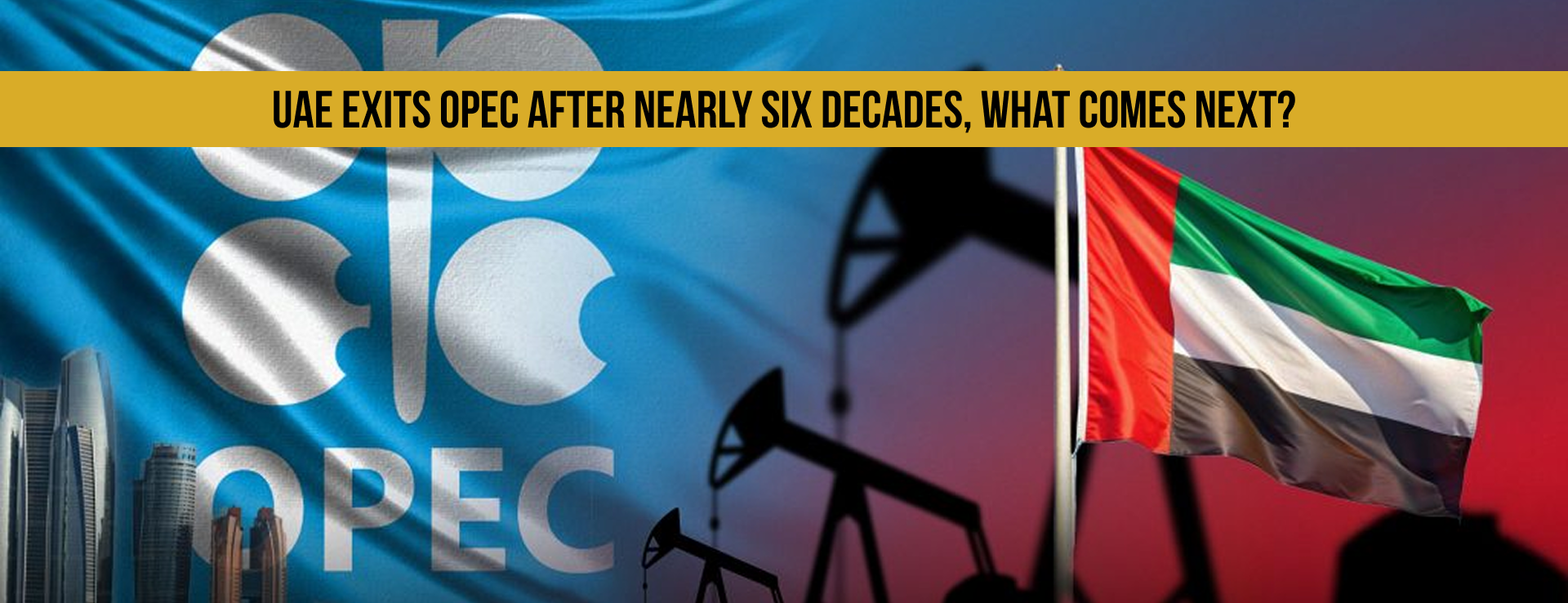
On April 28, 2026, the UAE made a historic announcement, marking a major shift after nearly six decades. It officially confirmed its plan to exit OPEC and the broader OPEC+ alliance effective on 1st May 2026.
To understand why the UAE made this move, it’s important to look at OPEC itself. The Organization of the Petroleum Exporting Countries which has long acted as a coordinating body for major oil-producing nations, managing supply to influence global prices. The UAE has been one of its key members and third largest oil producer behind Saudi Arabia and Iraq.
Against this backdrop, the decision ends nearly six decades of yearly participation in one of the world’s most powerful commodity alliances. It signals a turning point not only for global energy markets but for international trade and export strategy at large.
But this isn't just an energy story. It's a signal about how the global oil market is being restructured, how supply chains that run on fuel costs are going to be repriced, and what countries like India which depend on imported oil for over 80% of their energy needs should actually expect in the months ahead.
Why did the UAE Exit OPEC?
The official explanation is straightforward. UAE authorities said the decision followed a comprehensive review of production policy, future capacity, and long-term economic goals. OPEC has limitations on oil production capacity and UAE is a small yet one of the largest oil producers. In other words, the UAE had built the infrastructure to produce far more capacity but wasn’t allowed to do so because OPEC, which is largely led by Saudi Arabia, sets limits on how much each country can produce.
The UAE has long been contributing under its allotted quota for oil production as an OPEC member. But since these quotas capped output regardless of capacity, the UAE was unable to maximize its production potential. Meanwhile, Iraq and OPEC+ member Russia routinely exceeded their quotas with minimal consequences, while the UAE remained largely disciplined.
The UAE's goal is to reach 5 million barrels per day of production capacity by 2027 something OPEC quotas made difficult. Operating outside the cartel gives it the freedom to pursue that target on its own terms. There are also broader strategic factors involved. Since the early 2000s, the country has been going through economic diversification with a major focus on energy infrastructure and thus on positioning itself more flexibly in world markets.
This isn’t a sudden move. It’s a gradual shift that has been building for years.
What Changes in Global Markets Now?
The most immediate effect is the loss of a major force that assisted in keeping oil prices stable. OPEC’s strength has always been coordination. When a major producer like the UAE steps out, that coordination weakens. This can result in fluctuations in supply expectations, which at the end affects pricing.
There's significant risk of higher oil price volatility anytime in the near future. Hence, traders, refiners, and governments will closely watch how production levels change and how other OPEC members respond.
Operating outside the alliance allows the UAE to adjust production without coordinating with other producers. More supply, eventually, means downward pressure on oil prices. And cheaper oil has a direct pass-through effect on every part of the global supply chain including freight costs, manufacturing input costs, logistics, consumer goods pricing. The government said additional supply would be brought to market gradually, aligned with demand and prevailing conditions.
What Does This Means for OPEC?
OPEC loses more than a member, it loses part of its collective influence. Abu Dhabi joined OPEC in 1967, and the UAE retained that membership following the country’s formation in 1971. The UAE accounted for roughly 12 percent of OPEC’s output. This becomes more important when coordinating supply cuts or increases because a group's ability to manage supply depends on alignment. With fewer countries following production quotas, OPEC may find it harder to keep the oil market stable.
This follows a broader pattern, Qatar exited in 2019. Angola followed in 2024. The UAE’s departure is the most significant so far because of its scale and capacity growth ambitions. This doesn’t mean OPEC becomes irrelevant. It still includes major producers. But its influence now depends more heavily on smaller producers. Coordination becomes harder when major players prefer independence.
Why Does This Matter Beyond Oil?
Energy is the infrastructure of global trade. When a hub like the UAE exits OPEC, it isn't just about what you pay at the pump. It’s about the cost of bunker fuel for cargo ships and the price of raw materials for plastics and chemicals.
A UAE free from OPEC constraints can offer cheaper energy to its own domestic manufacturing zones. This makes spots like Jebel Ali and Fujairah even more competitive as re-export hubs. If you’re an exporter, the cost of doing business in this region is about to become a lot more interesting.
What Does it Mean for India?
Since India imports about 80-85 percent of its crude oil needs, it’s highly sensitive to these shifts. The UAE has long been one of India’s key crude suppliers and previously, Indian buyers had to negotiate with the “OPEC block” as a whole. Now, as the UAE is no longer bound by OPEC quotas, India can deal with the UAE as an independent seller.
In the short term, this could mean higher volatility. Independent production decisions can introduce uncertainty, and prices may fluctuate more frequently. That matters for a price sensitive economy like India’s.
Over the long term, the picture might improve. Direct negotiations become easier. Contract flexibility increases. India gains space to secure more competitive pricing and diversify its supply mix without cartel constraints. Weaker OPEC control could ultimately give India stronger negotiating power and more sourcing options.
What This Means for Global Import-Export Businesses?
For traders this is where real impact shows up. And if you’re actively trading across borders, a few practical implications are worth tracking:
Freight cost recalibration: If disruptions in the Strait of Hormuz reduce and global oil supply increases after the UAE’s exit, fuel costs for ships are likely to fall. This will impact the sea freight rates which have remained high due to shipping tensions in Gulf regions. This could gradually return to normal, although it's unclear how long it would take.
Energy-sensitive sectors face a pricing window: Many industries like chemical manufacturers, petrochemical traders, fertilizer producers, and plastic goods all have cost structures tied to crude. If oil prices fall over the medium term, businesses that buy energy-intensive products could benefit from lower costs, while sellers that based their pricing on expensive crude may face pressure on their profit margins.
The UAE as a bilateral trade partner grows in importance: The UAE is already India's third-largest trading partner, a global re-export hub, and a key pathway for goods flowing between Asia and the Middle East and Africa. Its shift to an independent producer strengthens its position as a direct commercial partner - for oil and for the broader trade relationship. Businesses with UAE supply chains or market exposure should pay attention to how the energy relationship evolves, because it affects the entire commercial context.
Supply chain planning becomes more variable: More volatile oil prices mean more variable logistics costs. Businesses that are locked in long-term freight contracts or set pricing based on stable fuel assumptions may need to revisit those models. Building in more flexibility - in contract terms, supplier diversification, and pricing structures - is a sensible response to a less predictable oil market.
Trade data tracking becomes more important: In periods of market transition when supply relationships are being renegotiated, when price signals are noisy, when trade routes are being reassessed, having access to real-time shipment data is the difference between reacting to change and anticipating it. Businesses that know where goods are actually flowing, at what prices, and through which channels are better equipped to make decisions in volatile periods.
The New Trade Compass
The UAE's exit from OPEC on May 1, 2026 is the most significant structural change to the global oil market in years. The UAE’s exit will not suddenly add huge amounts of oil to the market because exports are still limited by the Strait of Hormuz. However, it weakens OPEC’s control over managing oil supply and gives the UAE more freedom to decide how much oil it wants to produce and sell.
For India, it's a meaningful shift. The country goes from buying UAE oil as part of a coordinated OPEC basket to negotiating with the UAE as an independent seller with an active interest in moving more volume. That's a better negotiating position over time.
The near-term is complex. Hormuz disruptions, OPEC's response, oil price volatility, and the broader geopolitics of the Iran conflict will all add challenges. Businesses that track these shifts closely in real time, at the shipment and price level will navigate them better.
If you're an importer, exporter, or trader who needs to understand how energy shifts are moving your specific markets, supply costs, or buyer behaviour, EX-IM by The Dollar Business gives you shipment-level trade data and real-time market intelligence to track exactly that. Get in touch with us and schedule a demo!